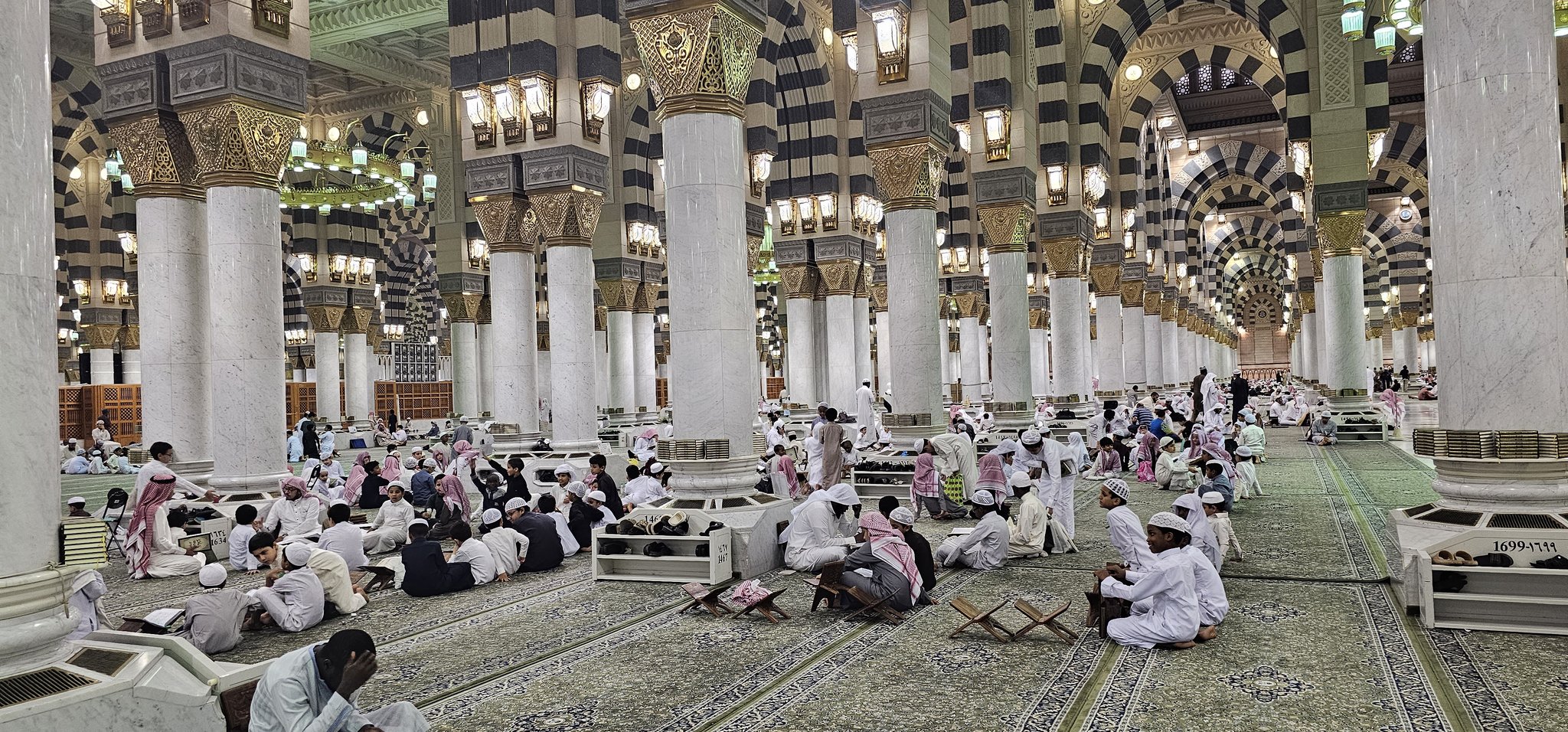
One of the most beautiful things about Islam is that it is not a religion built on private inspiration, isolated spirituality, or personal guesswork. It is a religion of revelation, transmission, memory, discipline, and living inheritance. We are taught to worship Allah, but we are also taught to learn how to worship Him properly. We are taught to believe, but also to understand what we believe and why. We are taught to live sincerely, but also to seek guidance from those who came before us and who have spent their lives preserving sacred knowledge.
That is why learning holds such an elevated place in Islam. Allah says, “My Lord! Increase me in knowledge,” and this is one of the few things the Prophet ﷺ is explicitly commanded to ask for more of. Allah also says that He raises those who believe and those who have been given knowledge in rank. Knowledge in Islam is not a hobby for intellectuals. It is a means of nearness to Allah, a protection from error, and a light by which the believer walks.
The Prophet ﷺ taught that whoever takes a path in search of knowledge, Allah makes the path to Paradise easy for him. He also taught that the scholars are the heirs of the Prophets, because the Prophets did not leave behind wealth, but knowledge. These two teachings alone explain much of why Islam places such enormous emphasis on learning. Sacred knowledge is not extra. It is part of the path to salvation, and the scholars are honored because they preserve and pass on the prophetic inheritance.
Many people, especially when they are new to Islam, wonder why there is such an emphasis on studying with teachers. Why not just read Qur’an and hadith by oneself? Why listen to scholars at all? Why do great sheikhs often say they studied under ten, twenty, or even fifty teachers? Would it not be simpler to find one trusted person and learn everything from him alone?
The answer begins with humility. Islam teaches us that truth is objective, but our understanding is limited. The Qur’an is perfect; we are not. The Sunnah is pure; our reading of it may be partial, immature, or unbalanced. A person who only teaches himself often does not realize where his own blind spots are. He may read a verse without knowing its context, read a hadith without knowing how scholars reconciled it with others, or adopt a strong opinion without realizing that great scholars differed on the matter. The problem is not sincerity. The problem is that sincerity without guidance is still vulnerable to error.
This is why Islam became, from its earliest generations, a religion of companionship and transmission. The Companions learned from the Prophet ﷺ directly. The generation after them learned from the Companions. The scholars after them learned from those who had learned from the Companions. Islam was not preserved merely in books, but in hearts, voices, explanations, habits, character, correction, and living chains of instruction. One learns not only information from a scholar, but also method, balance, etiquette, priorities, restraint, and fear of Allah.
A real scholar does not merely tell you what the religion says. He helps you understand how the religion is understood. He shows you how to distinguish what is clear from what is ambiguous, what is foundational from what is secondary, what is agreed upon from what is disputed, and what requires certainty from what allows legitimate difference. This is one of the great reasons scholars matter so much in Islam. Without scholarship, religion becomes vulnerable to ego, slogans, outrage, internet fragments, and personal preference dressed up as piety.
When Muslims speak of “sitting at the feet of scholars,” they do not mean blind hero-worship. They mean taking knowledge with adab, humility, and gratitude. They mean recognizing that sacred learning is not the same as consuming content. A lecture online may benefit you, a book may inspire you, and a translation may help you, but formation in the religion has always involved receiving knowledge from those who themselves received it carefully. The very posture matters. You come to learn, not to dominate. You come to be corrected, not merely affirmed. You come to be shaped, not merely informed.
This is also why so many great scholars studied under many different teachers. It was never simply about collecting names. It was about breadth, precision, maturity, and protection from narrowness.
One teacher may excel in Qur’an, another in hadith, another in Arabic, another in fiqh, another in legal theory, another in spirituality, another in the diseases of the heart, another in inheritance law, another in the biographies of narrators, another in the history of the madhhabs, and another in teaching people how to live what they know. No one human being encompasses every excellence in the same degree. Even the greatest scholars benefited from specialists in different fields. To study with many teachers is to acknowledge that Allah distributed gifts widely across the Ummah.
There is also another wisdom here: studying with different scholars protects a person from mistaking one man’s personality, culture, temperament, or habits for Islam itself. One teacher may be very strict by temperament. Another may be gentle. One may emphasize legal precision. Another may emphasize purification of the soul. One may come from one land, another from another. When a student learns only from one figure, he may unconsciously absorb that teacher’s personal style as though it were the whole religion. But when he sits with several grounded scholars, he begins to see the breadth, mercy, depth, and balance of the tradition.
This is especially important in an age like ours, when many people build their religion around a single charismatic speaker. That can be spiritually dangerous. Every human being has limits. Even a good teacher may have blind spots, weaknesses, or gaps in emphasis. A student who knows only one voice can become fragile. If that teacher errs, the student may collapse with him. If that teacher has an imbalance, the student may inherit it. If that teacher speaks outside his expertise, the student may not know the difference. Learning from multiple qualified scholars helps anchor a person in the tradition rather than in a personality.
At the same time, Islam does not teach restlessness or shallow sampling. There is a difference between learning from many scholars and constantly hopping from one speaker to another looking only for novelty. The first builds depth. The second often produces confusion. The goal is not to become a collector of clips, quotations, and brand loyalties. The goal is to become rooted in the religion. A serious student learns from multiple trustworthy people, but he learns in an ordered way. He studies patiently. He respects specialization. He does not chase controversy. He does not confuse confidence with knowledge.
So why study so much? Because Islam is not shallow.
To know how to pray correctly, how to purify oneself, how to fast, how to marry, how to earn lawfully, how to repent, how to honor parents, how to raise children, how to speak truthfully, how to avoid oppression, how to make dhikr, how to understand trials, how to guard the heart, how to distinguish orthodoxy from innovation, how to read the Qur’an soundly, and how to die in a state pleasing to Allah—these are not small matters. They shape a human life. The more one sees the weight of the religion, the more one realizes how much there is to learn.
This is not a call for every Muslim to become a formal scholar. It is a call for every Muslim to honor knowledge and pursue what he or she needs sincerely. There is knowledge that is obligatory for every believer: what one must know to believe correctly, worship correctly, and live faithfully. Then there is deeper specialized knowledge carried by scholars, muftis, jurists, hadith experts, and teachers. The average Muslim does not need to master every discipline, but he should know enough to worship Allah with clarity and enough to know whom to trust when deeper questions arise.
This is another reason scholars are so important. Not everyone can independently derive rulings from the Qur’an and Sunnah. Not everyone can evaluate hadith chains. Not everyone knows Arabic at a level sufficient to weigh legal nuance. Not everyone can sort through centuries of commentary and disagreement. The existence of scholars is therefore a mercy. They do for the community what most individuals cannot do for themselves. They preserve, clarify, teach, warn, explain, reconcile, and transmit. They help keep the Ummah attached to revelation rather than drifting with the mood of the age.
But Islam’s reverence for scholars is not unconditional or naïve. Scholars are honored because of what they carry, not because they are beyond criticism. They are respected, but not worshipped. They are followed insofar as they follow the Qur’an and Sunnah. A scholar’s status does not make him infallible. That belongs only to the Prophets in the sense relevant here. So when Islam tells us to honor scholars, it is not calling us to abandon discernment. It is calling us to respect knowledge, to recognize expertise, and to keep proper manners with those who have devoted themselves to sacred learning.
This balance matters. On one extreme are those who despise scholarship and think religion can be reinvented from a translation and a search engine. On the other extreme are those who treat a scholar as though every personal opinion he speaks is beyond question. The sound path is in the middle: reverence without fanaticism, humility without gullibility, trust without blind imitation.
There is something else that must be said here. In Islam, learning is not only about information. It is also about transformation. A person may know many facts and still be arrogant, harsh, heedless, and immature. That is not the knowledge Islam praises. The knowledge praised in the Qur’an and Sunnah is knowledge that produces humility, obedience, awe, and sincerity. If learning does not soften the heart, deepen taqwa, and correct the self, something has gone wrong. The best scholars are not only those who know the most texts, but those whose knowledge has ripened into character.
That is one reason why sitting physically or spiritually with scholars matters so much. You watch how they speak. You see how they handle disagreement. You observe whether knowledge made them gentle or vain. You learn patience from the patient teacher, seriousness from the serious teacher, balance from the balanced teacher, and God-consciousness from the teacher whose speech reminds you of Allah. Books transmit information. Scholars, at their best, transmit formation.
This also explains why the great sheikhs of the Ummah often speak so lovingly of their own teachers. They are not merely naming credentials. They are expressing gratitude for links in a chain of mercy. In Islam, to have teachers is an honor. It means you did not invent yourself. It means you were carried by others. It means your knowledge came through service, listening, correction, and humility. It means you belong to a living inheritance.
And in truth, studying under many teachers can also protect the soul from pride. The person who learns only from himself is tempted to imagine he is self-made. The person who sits with many scholars is constantly reminded of his dependence, his incompleteness, and the vastness of what he does not know. He begins to understand why the greatest people in this religion remained the most humble. The deeper they went, the more they realized the ocean had no shore.
For new Muslims especially, this is an important lesson. You do not need to know everything immediately. You do not need to become a scholar overnight. You do not need to panic because there is so much to learn. What you need is a sound beginning: sincere intention, steady practice, trustworthy teachers, and patience. Learn the essentials well. Stay close to the Qur’an. Love the Sunnah. Ask questions. Avoid arrogance. Do not confuse loudness with scholarship. Do not take your religion from the most sensational voice online. Look for people of knowledge who are grounded, balanced, reverent toward revelation, connected to the scholarly tradition, and visibly shaped by taqwa.
And yes, learn from more than one scholar, but do so wisely. Let one teacher help you in creed, another in Qur’an recitation, another in fiqh, another in purification of the heart. Benefit from different strengths. Let the tradition become wider and deeper in your sight. But do not become scattered. Do not live on fragments. Build slowly and deliberately.
In the end, the emphasis on learning in Islam comes from the nature of Islam itself. This religion came as guidance. Guidance must be understood. It must be preserved. It must be taught. It must be handed down faithfully. That is why knowledge is beloved. That is why scholars are honored. That is why students travel, listen, memorize, ask, compare, and sit humbly before those who know more than they do.
To sit at the feet of scholars is not to lower yourself before men. It is to humble yourself before the truth. It is to admit that Allah guides through means, and among the greatest of those means are the people who inherit the knowledge of the Prophets. The seeker of knowledge does not study because information is impressive. He studies because he wants to worship Allah correctly, love Him more deeply, and walk the straight path with light instead of guesswork. That is why the righteous never tired of learning. They knew that every true lesson, rightly received, was one more step toward Allah.